
The Masters Have Done Their Part
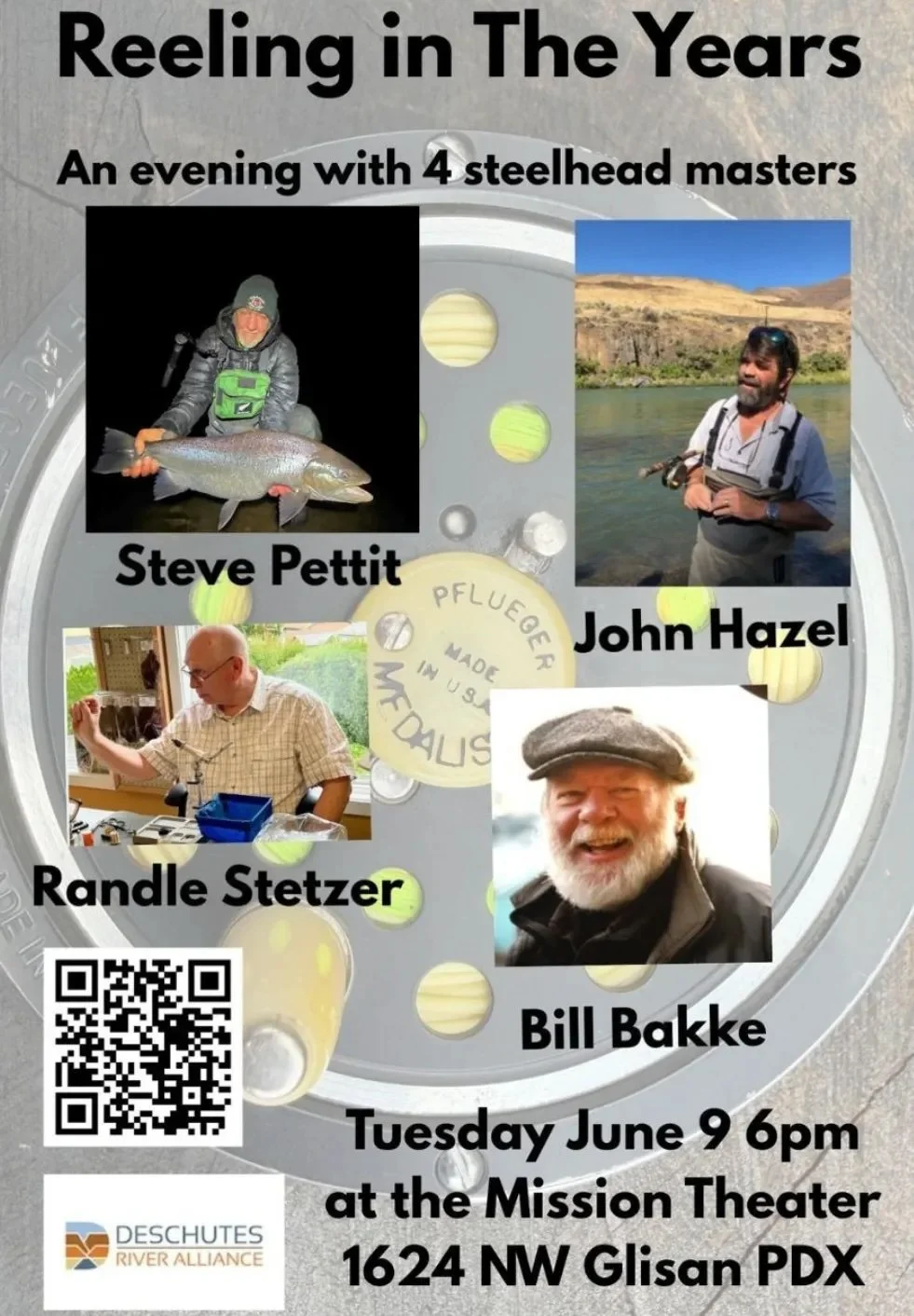
Recently, five men shared a stage at the Mission Theater in Portland, and between them, they carried close to two and a half centuries of life spent on Pacific Northwest rivers. Steve Pettit. Bill Bakke. John Hazel. Randle Stetzer. Bill McMillan. The event, called Reeling In the Years, deserved a full house.
But listen carefully, because the most useful thing these men can tell us is not how they fished with floating lines and fiberglass rods for fish that ran thick enough to make your hands shake. It’s what they did when the fishing started to disappear.
We have built an entire culture around the wrong half of that story. Open any fly fishing magazine, scroll any feed, and you’ll find the genre fully formed: the elegy, the reverence for the old runs, the old lines, the old hands. We’ve turned steelheading into a memory palace, and we roam its rooms, touching the relics. It is beautiful. It is also, increasingly, a way of not looking at the current state of steelhead.
Here is what gets lost by the candlelight. Bill Bakke did not start Oregon Trout and the Native Fish Society to be remembered. He founded them because the fish were in trouble and somebody had to do the unglamorous, infuriating work of fighting agencies, reading hatchery data, and standing in hearing rooms. Steve Pettit didn’t spend more than thirty years as a fish passage specialist for Idaho Fish and Game because passage specialists get statues. He did it because the dams were killing smolts and the math demanded a witness who wouldn’t blink. Bill McMillan didn't spend decades snorkeling the Washougal and the Skagit, recording wild steelhead counts by hand, then turn that data into testimony, because anyone was paying him to. He did it because somebody had to keep the record, and the record was the only thing that would hold up when the agencies looked away. These men became conservationists out of alarm, not nostalgia. The pioneering was never the point. The stewardship was the point.
So, the question this event and others pose is, what does the future hold for the sport? The answer is baked into the lives of the five people answering it. The future holds exactly as much steelhead fishing as we are willing to fight for. Not mourn. Fight for.
And the fight has moved. It is no longer on the swing run. Consider what is happening on the rivers while some of us celebrate the past.
In the Interior Fraser, the collapse has nearly finished. During the summer 2025 migration window, the DFO test fishery at Albion did not detect a single Interior Fraser steelhead. From that catch, the province now forecasts a 2026 Thompson spawning population of fewer than 19 fish, and a Chilcotin forecast of fewer than 9. There is a 97 percent probability that the Thompson population will be classified as an Extreme Conservation Concern, and a 99 percent probability for the Chilcotin. As one biologist put it, a single slide or a single storm could wipe out a spawning population forever. These are runs that were still in the hundreds a few years ago. We are now counting them on our fingers.
And the killing detail, the one that should make every angler in that theater sit up, is that this was preventable. Back in 2019, when the Thompson returns were still in the hundreds, the Committee on the Status of Endangered Wildlife in Canada assessed both populations as endangered and recommended listing them under Canada’s Species at Risk Act, which would have triggered real protections and recovery. It never happened, in part because officials at Fisheries and Oceans Canada corrupted the process. The fish didn’t fail. The institutions did. They failed in the exact arenas, listings, recovery plans, monitoring budgets, where Bakke and Pettit spent their careers throwing their bodies against the gears.
It’s the same pattern closer to home. The Skagit was closed this season not because the fish failed but because nobody funded the people who count them; monitoring is the load-bearing wall, and when the appropriation disappears, the season disappears with it. DFO budget cuts are gutting monitoring on the Skeena, the single most important steelhead watershed left on the continent, the one place where the runs are still real. And under the Pacific Salmon Treaty, up for renegotiation before 2028, wild steelhead remain nearly invisible in interception accounting, as fish taken in mixed-stock fisheries go uncounted against any wild steelhead ledger.
Look at that list. The threats are no longer the romantic ones. They are appropriations line items, treaty annexes, escapement models, emergency listings that get quietly buried, and the slow administrative erasure of the very data we’d need to prove anything. This is not a fight that rewards reverence. It rewards the unsexy persistence that Bakke and Pettit modeled for fifty years, the willingness to be the person in the room who reads the document.
I worry that our nostalgia has become a kind of permission slip. If we are gathered in a theater remembering how good it was, we don’t have to sit with how bad it is, or how much of the badness is ours to fix. Veneration is comfortable. It asks nothing of you but attendance and a lump in the throat. The masters never had that luxury. When they saw the runs decline, they didn’t convene a panel to remember them. They went to work.
There’s a generational sleight of hand in all this; by keeping the lights trained on the pioneers, we excuse ourselves from becoming the next ones. We tell ourselves the giants already walked the earth, that ours is a diminished age, that all we can do is tend the flame. That’s a lie, and a cowardly one. The thirty-year-olds wading the Hoh this winter are not curators of someone else’s legend. They are the Bakkes and Pettits of a fight that is, by every measure, more urgent than the one their predecessors inherited. The treaty reopens. The appropriations get voted on. The monitoring money exists somewhere if someone makes the case for it. The Thompson can still be listed late, against the odds.
So here is what I’d offer, along with the standing ovation these four men earned: let it be one of the last ovations that points only backward. Let that night be the start of us stopping building shrines and starting to read their lives as instruction manuals. Pettit fought for the smolts. Bakke built the institutions. McMillan kept the record. Hazel and Stetzer turned a lifetime on the water into advocacy for the water. None of that is behind us. All of it is the assignment.
The masters were never trying to give us something to remember. They were trying to leave us something to do.
So don’t just remember, get involved. Volunteer, support organizations, and advocate for stronger protection. The future of steelhead depends on what you do next.
The fish are down to single digits in the Chilcotin.
Brian Bennett writes about wild steelhead and fisheries policy. He is Communications Manager at the American Fly Fishing Trade Association, the Wild Steelhead Coalition, and Tomorrow’s Fish. The opinions expressed are the author’s own.