
The Ocean Sent a Warning
The closures now confronting steelhead anglers on Oregon's Deschutes and North Umpqua rivers are painful. They affect anglers, guides, businesses, communities, and a fishing culture built around some of the world's most storied wild steelhead rivers. But the most important thing about these closures is not that fishing opportunity has been lost. It is why.
Wild steelhead are once again returning in numbers too low to justify business as usual. And while there is no single explanation for a poor steelhead return, one of the major forces shaping the fish coming home today was visible before many of them had spent their first year at sea: deteriorating ocean conditions.
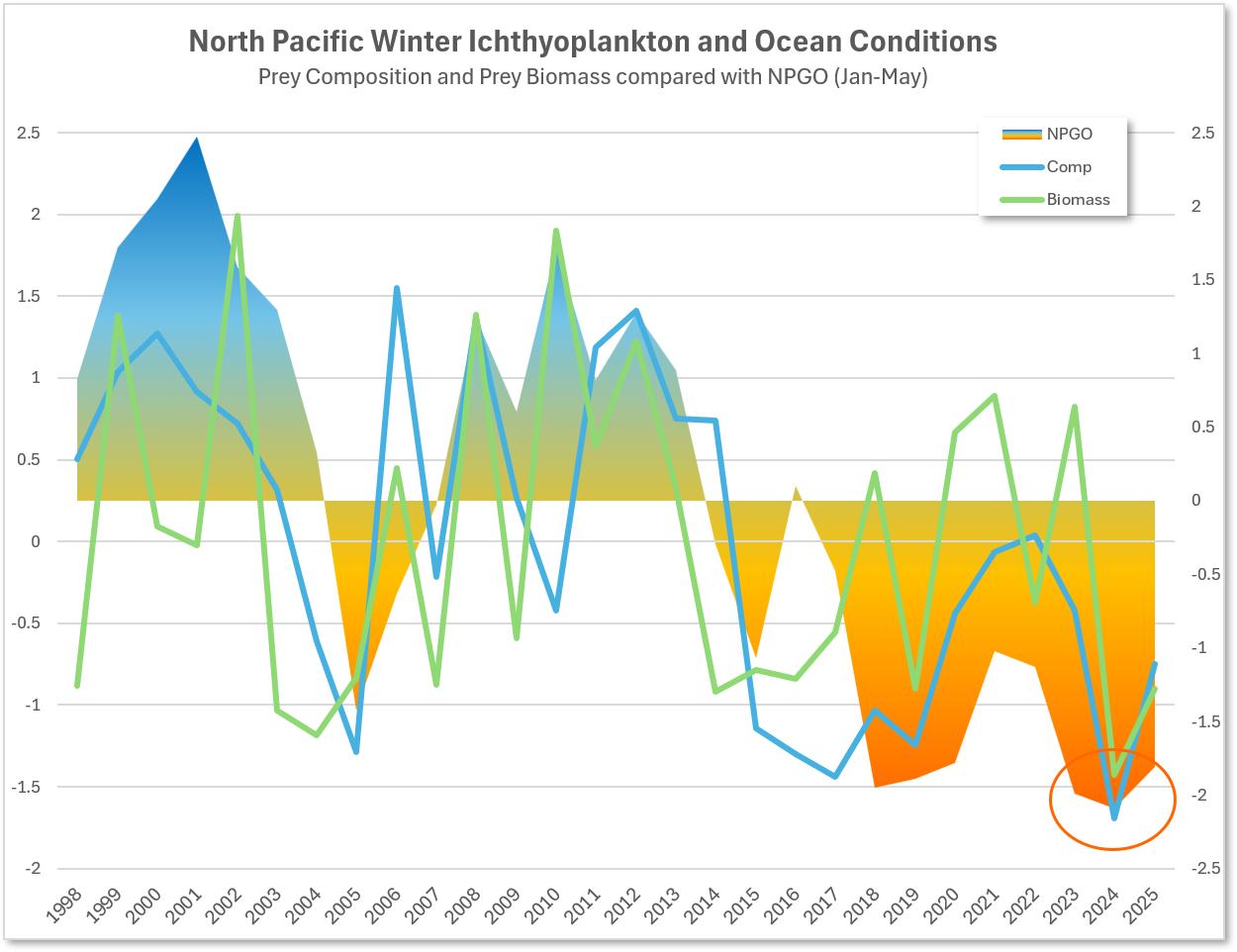
In December 2024, the Wild Steelhead Coalition highlighted troubling results from NOAA Fisheries' ocean ecosystem monitoring off the Pacific Northwest. The indicators were unusually poor for juvenile salmon and steelhead entering the ocean that year.
The warning signs were difficult to miss. NOAA researchers documented the lowest coastal prey biomass observed in the survey's time series and the worst-ranked ichthyoplankton community conditions associated with salmon and steelhead survival in 27 years. The composition of the food web had shifted away from the productive nearshore species that juvenile salmonids depend on. Other ocean indicators also pointed toward warmer, less productive conditions.
As we wrote then, the implications remained straightforward: juvenile steelhead entering the Pacific were facing conditions associated historically with lower marine survival and, eventually, fewer adults returning to our rivers. Those juveniles are today's returning adults.
That does not mean ocean conditions alone explain every missing steelhead in the Columbia Basin or North Umpqua. Steelhead face a cumulative gauntlet of threats: dams and migration barriers, degraded freshwater habitat, high water temperatures, drought, predation, hatchery interactions, harvest and fisheries impacts, and a changing climate. But the ocean is an enormously important part of the equation. And unlike a dam, a degraded tributary, or a fishery regulation, managers cannot repair the North Pacific with an emergency rule. They can, however, decide how much additional risk we impose on the fish that survive it.
On July 31, the Oregon Department of Fish and Wildlife announced that steelhead and salmon fishing on the Deschutes River will close beginning August 15 because of the poor return of wild upriver summer steelhead. The numbers triggered the conservation threshold established under Oregon's Deschutes River Steelhead Management Framework. Between July 1 and July 31, just 7,388 wild steelhead passed Bonneville Dam. The framework calls for at least 9,900 during that period for the fishery to remain open.
The wider context is even more sobering: ODFW acknowledges that upriver summer steelhead returns have been poor for more than a decade.
These are not simply fish headed for the Deschutes. The upriver run includes wild steelhead bound for rivers throughout the Columbia and Snake basins, including populations protected under the Endangered Species Act. After passing Bonneville Dam, some of these fish must negotiate as many as eight dams before reaching their spawning grounds.
The North Umpqua is delivering another warning.
That river's legendary wild summer steelhead population has struggled repeatedly in recent years, including the historically poor 2021 return. ODFW has previously identified a combination of drought, wildfire, low flows, high stream temperatures, and poor ocean conditions as pressures influencing the population. Now another closure is necessary to reduce angling impacts on an already diminished run.
Different rivers. Different steelhead populations. Different management systems. But the lesson is remarkably similar. When abundance falls, every surviving wild fish becomes more important.
Emergency closures should be the last line of defense.
The real conservation decisions happen years earlier, when managers determine how much mortality depleted populations can sustain, whether fisheries should operate near minimum abundance thresholds, how much uncertainty is incorporated into forecasts, and whether a few years of improved returns justify relaxing protections.
This is precisely why the Wild Steelhead Coalition argued for caution in 2024.
That year brought encouraging steelhead returns in parts of the Northwest. More than 21,000 unmarked summer steelhead had passed Bonneville Dam by the end of July, the highest run to that point in nearly a decade. It would have been easy to interpret those numbers as evidence that steelhead had turned a corner. But those adults had gone to sea under different conditions. The ocean indicators for juveniles entering the Pacific in 2024 were telling us something very different about the fish likely to return in subsequent years.
Good returns should never erase the lessons of bad ones. Steelhead populations fluctuate naturally, and marine survival can change dramatically from one generation to another. That variability is precisely why management must be precautionary. When environmental indicators imply that future survival may decline, the responsible response is not to seize every available opportunity during a temporary surge. It is to preserve resilience for the weaker years that may follow.
No fishing closure will cool the North Pacific. Closing the Deschutes will not increase coastal plankton productivity. Catch-and-release regulations will not reverse marine heat waves. Eliminating a few angler encounters will not rebuild degraded habitat or remove dams.That is not an argument against conservation measures. It is the argument for them.
When environmental conditions outside our immediate control become less favorable, the pressures we can control become more important.
That means protecting cold-water habitat and restoring access to tributaries. It means improving dam passage and reducing delayed mortality during migration. It means carefully evaluating hatchery programs and their effects on wild populations. It means reducing harvest and incidental mortality when abundance declines. And it means managing recreational fisheries conservatively enough that enough wild fish reach the spawning grounds to sustain the diversity and productivity populations will need in an increasingly unpredictable climate. Most importantly, it means resisting the temptation to manage wild steelhead according to the best year we've recently experienced.
We recognize what closures cost. Steelhead anglers are among the people most invested in these rivers. Guides depend on fishing seasons for their livelihoods. Rural businesses depend on visiting anglers. And generations of people have built traditions around returning each summer or fall to rivers such as the Deschutes and the North Umpqua. Losing that opportunity matters. But the greater loss would be allowing fishing opportunity today to undermine the possibility of fishing tomorrow.
ODFW's decision to close the Deschutes when the established conservation threshold was not met is exactly what a management framework is supposed to do. Biological thresholds mean very little if they disappear whenever complying with them becomes inconvenient. The same principle should apply throughout wild steelhead management.
We should establish meaningful conservation thresholds before populations reach crisis levels. We should incorporate environmental indicators into management decisions. We should account explicitly for uncertainty. And when the science tells us that the next generation of fish is entering a hostile ocean, we should respond before those fish return as depleted adults, not after.
The lesson of 2026 should not simply be that ocean conditions can produce poor steelhead returns. We already knew that. The lesson should be that conservation is most effective when it anticipates the downturn rather than reacts to it.
Two years ago, the ocean gave us a warning. Today, the rivers and the fish are delivering the message.