
The Run Isn't Just Smaller - It's Simpler
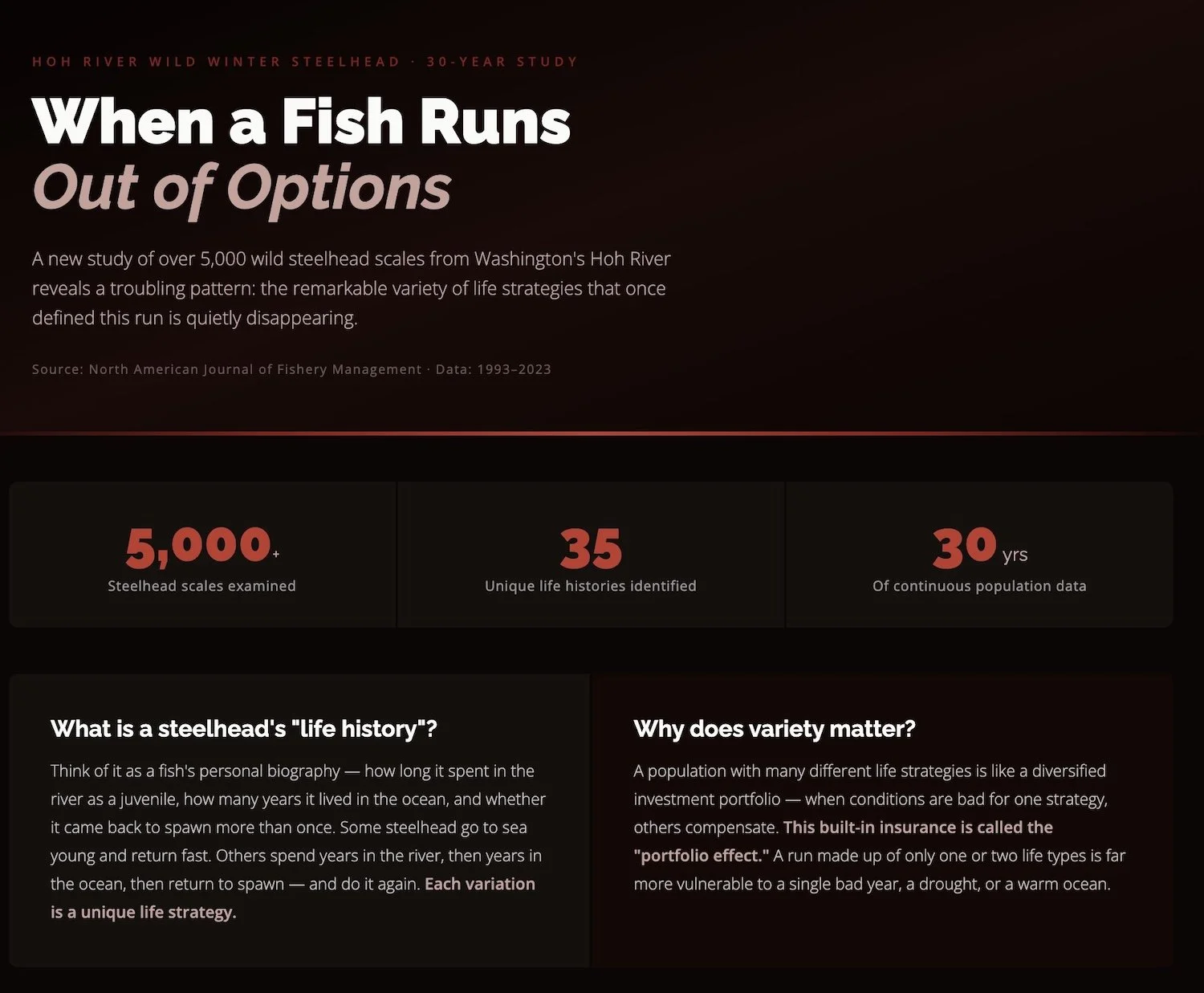
Thirty years of scale data from Washington's Hoh River reveal a population quietly losing its options — 35 unique life histories documented, and a diversity that's been shrinking since 1994.
A recent study published in the North American Journal of Fishery Management documents three decades of demographic change in wild winter steelhead in Washington's Hoh River. Analyzing growth patterns from more than 5,000 steelhead scales, researchers found that life history diversity, the mix of freshwater and ocean ages represented in spawning runs, has declined markedly from 1994 to 2023.
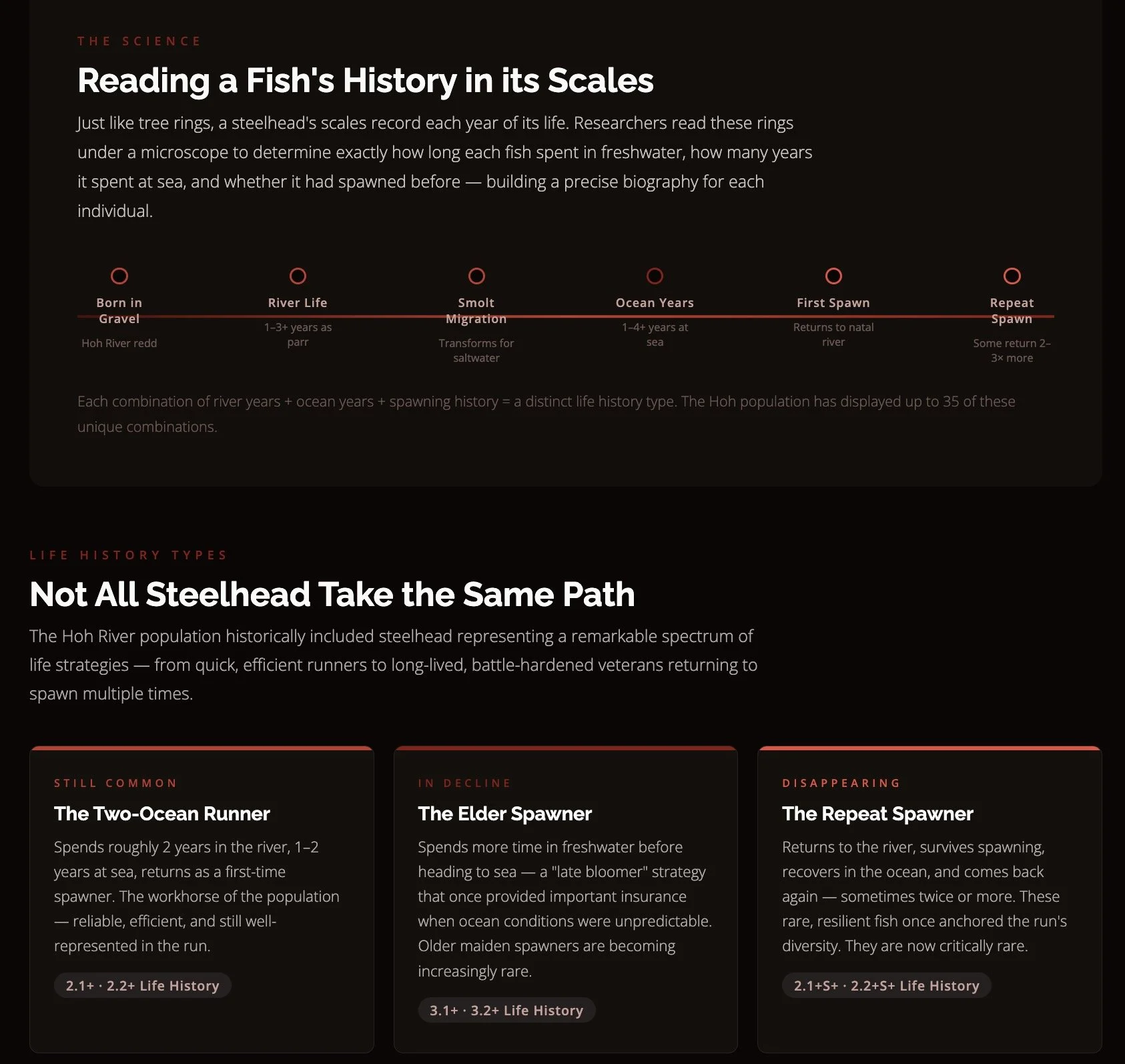
A steelhead's scales are its biography. Researchers used that record to classify every fish by its freshwater years, ocean years, and spawning history, and found that the Hoh's most resilient fish types are disappearing.
The researchers identified up to 35 unique life histories among Hoh River steelhead, but their diversity, measured by the Shannon Diversity Index, has been shrinking. The primary drivers: fewer repeat spawners (kelts) and fewer older maiden spawners entering the system. This matters because life history diversity is a population's hedge against environmental uncertainty. Repeat spawners, in particular, are critical for both productivity and genetic diversity. As that diversity narrows, so does the population's capacity to absorb and adapt to environmental stress.
This finding lands in a grim context. Across the continental United States, several distinct ecological groups of wild steelhead are already extinct. Most remaining populations are listed as threatened or endangered under the Endangered Species Act, not just at record-low numbers, but also compressed into diminished age structures and distorted, constricted run timing.
So what should a healthy wild steelhead population actually look like?
Look east, to Russia's Kamchatka Peninsula. Kamchatkan steelhead exhibit extraordinarily diverse life histories, ranging from two-year-old half-pounders to 11 and 12-year-old multiple-repeat spawners. The result is a spawning population drawing from many year classes simultaneously, with no single year class contributing more than roughly 20% to any given year's run. That's resilience made visible.
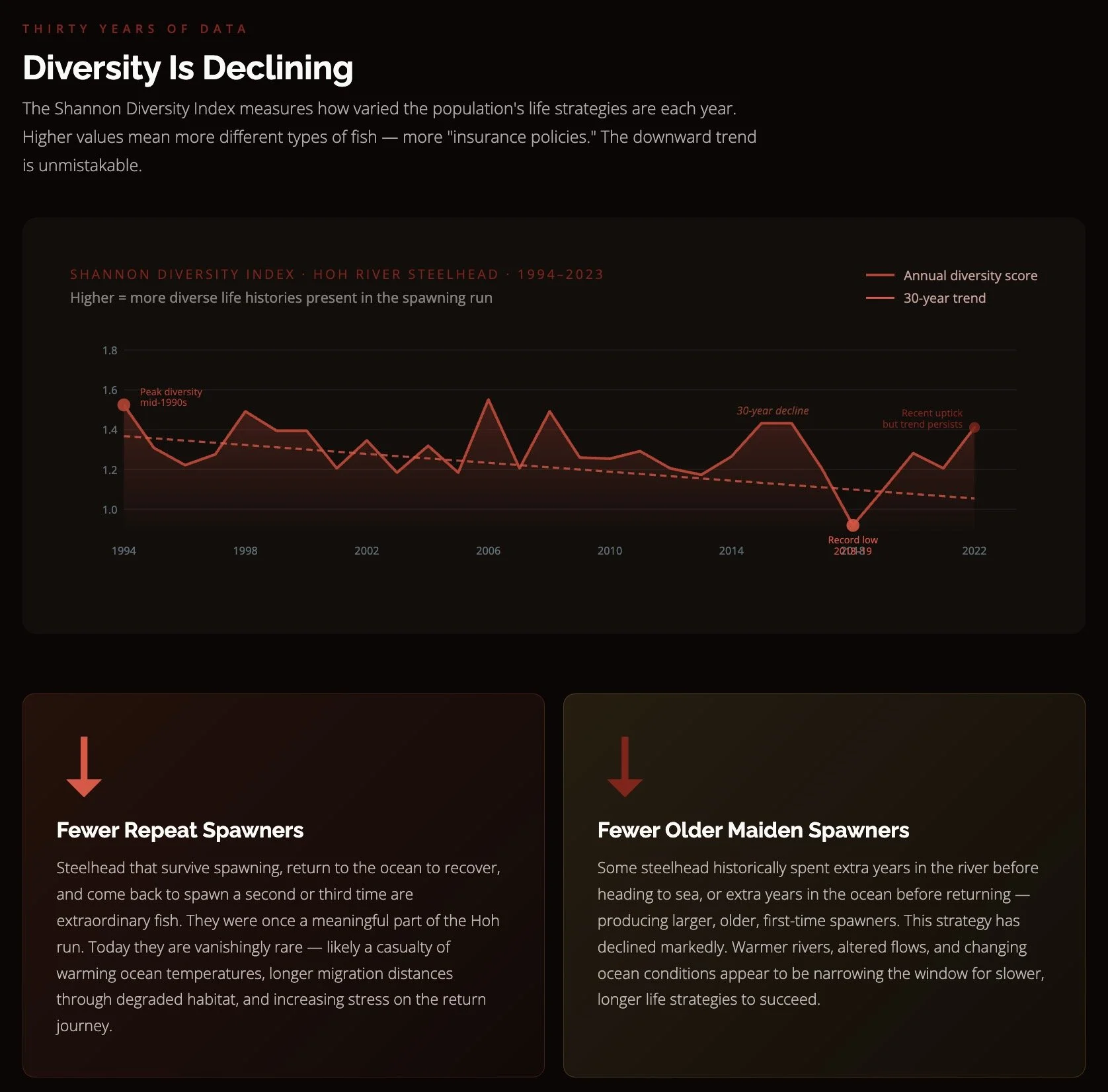
The Shannon Diversity Index doesn't lie. From peak diversity in the mid-1990s to a record low around 2018–19, the 30-year trend line points in one direction, driven by the loss of repeat spawners and older maiden fish.
The study's conclusion points to one path forward for declining wild steelhead populations: restoring life-history diversity. That means moving beyond our current narrow focus on abundance, escapement numbers, and instead providing sufficient survival across different run types so that natural diversity can re-establish itself: broader age structure, more repeat spawners, and run timing dynamically tuned to individual watersheds.
The researchers also found that annual survival rates for repeat spawners were positively correlated with life-history diversity, further evidence that protecting kelts isn't a conservation nicety; it's a demographic necessity.
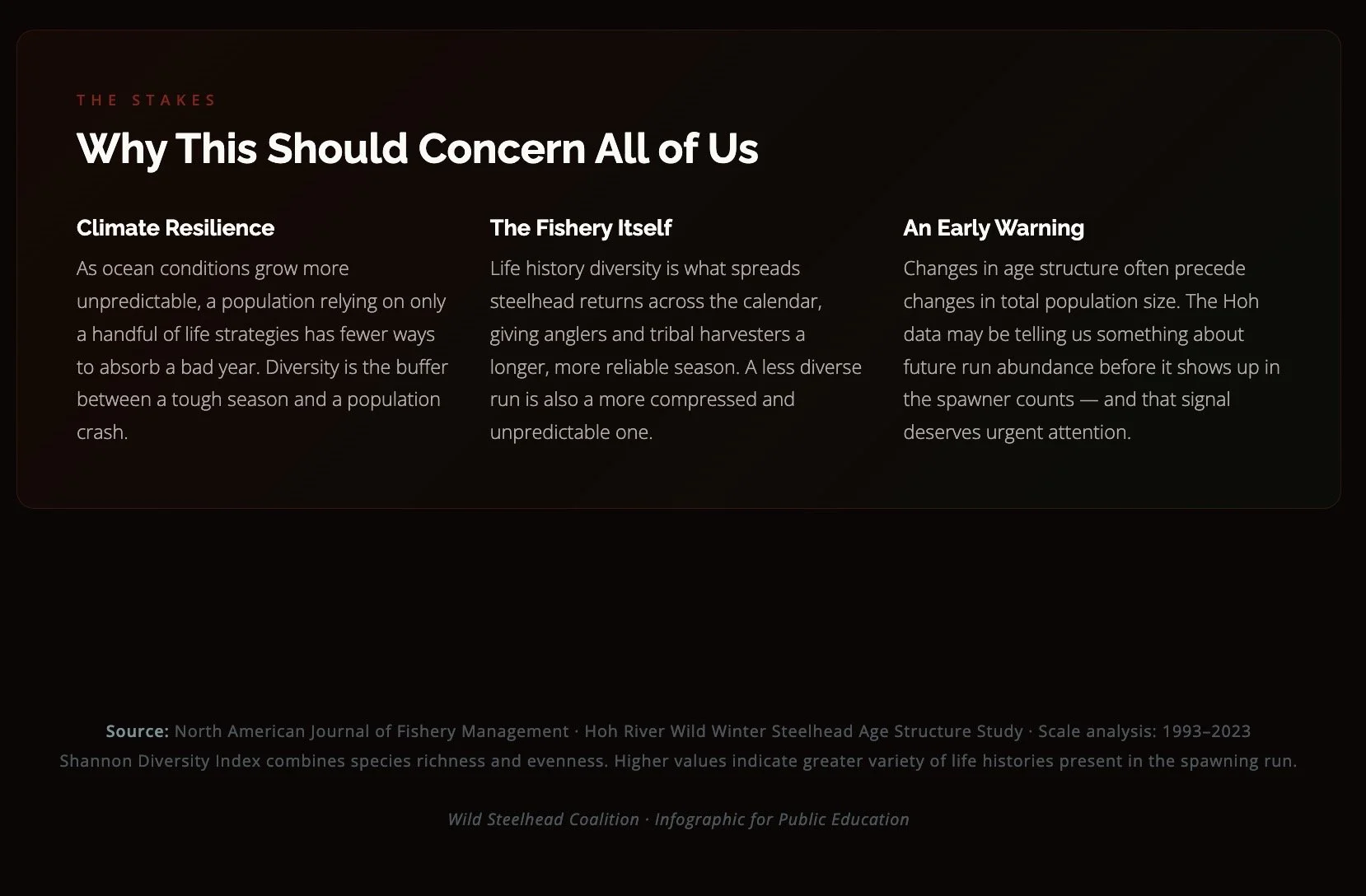
Life history diversity isn't an abstraction. It's what buffers a population against a bad ocean year, what extends the fishing season for anglers and tribal harvesters, and what may be signaling a future abundance crash before the spawner counts catch up.
A management approach capable of recovering wild steelhead must account for all life histories, not just total counts. Fishing regulations, habitat protection, and population assessments should reflect the full life-history composition of each population, not just whether enough fish crossed the line.
That would be true stewardship.