Cold Water, Culverts, and the Future of Idaho’s Wild Salmon and Steelhead
There’s a moment described in a recent NOAA Fisheries feature that cuts through the abstraction of policy debates.
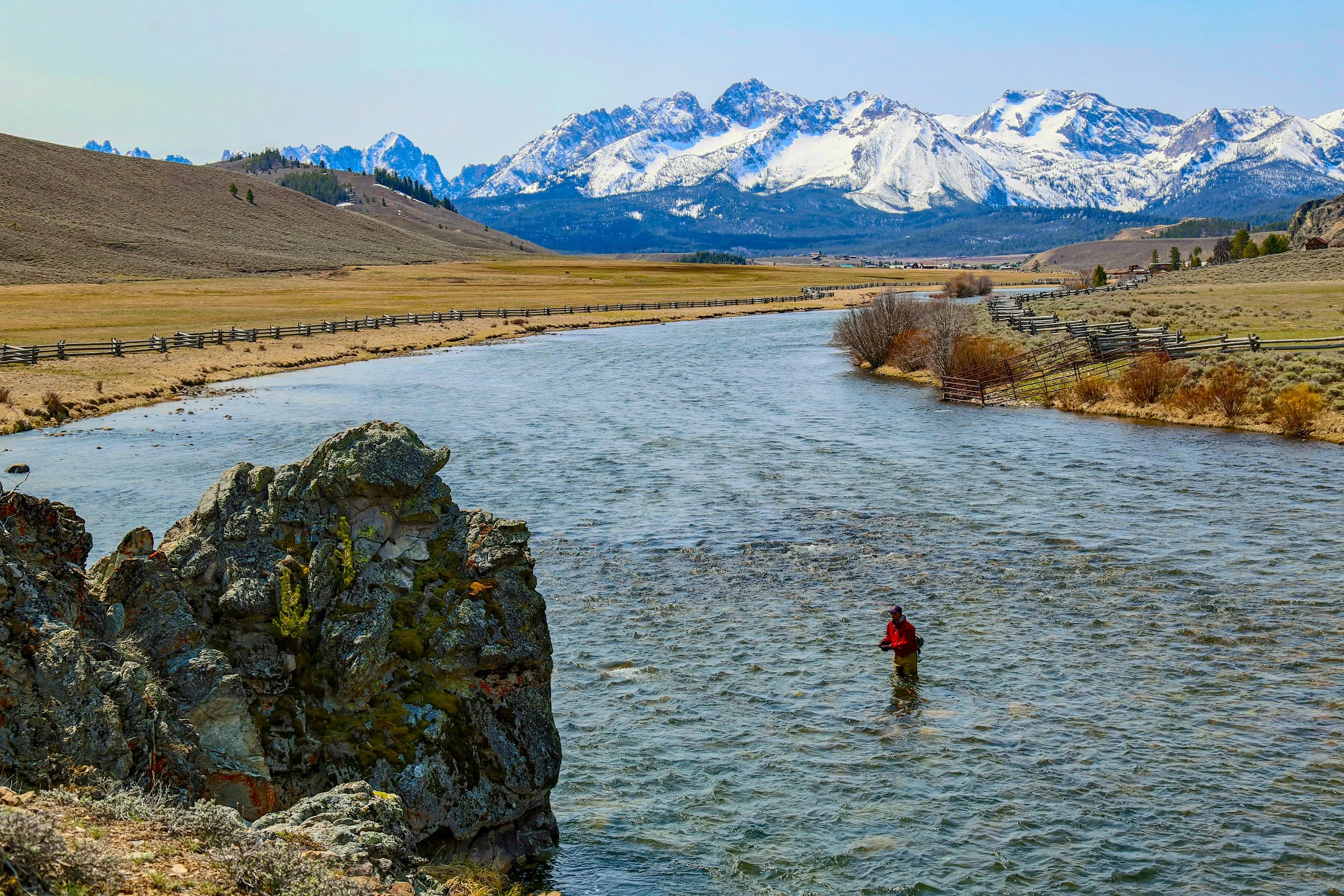
On Idaho’s Yankee Fork of the Salmon River, Chinook salmon began building redds in spawning gravel that had been placed just three weeks earlier as part of a habitat restoration project led by the Shoshone-Bannock Tribes and Trout Unlimited. The fish didn’t wait for a ribbon-cutting. They found cold, clean, accessible water and used it.
Rapid recolonization of restored habitats like this is well documented in fisheries science and frequently cited by NOAA and state agencies as evidence that, when physical conditions improve, salmon and steelhead respond quickly.
That moment, and thousands like it across the Columbia River Basin, depend on federal habitat restoration funding that is now under renewed budget pressure.
Snake River Chinook and steelhead undertake one of the longest freshwater migrations in the continental United States, roughly 900 miles from the Pacific Ocean to spawning grounds in central Idaho. Along the way, they pass eight mainstem dams on the Columbia and Snake rivers, navigate warming reservoirs, and face predation and shifting ocean conditions.
Wild runs that once numbered in the millions have declined dramatically over the past half-century. While estimates vary by run and baseline, declines of 80–90 percent are widely cited in federal and academic assessments. Today, Snake River spring/summer Chinook and steelhead are listed as “threatened” under the Endangered Species Act.
At the same time, the basin remains central to any recovery strategy. Federal agencies and conservation groups often note that the Columbia-Snake system contains a substantial share, frequently described as roughly half, of the remaining high-quality cold-water habitat for salmon in the lower 48 states.
The habitat still exists. The question is whether fish can reach it.
Large infrastructure, particularly the four lower Snake River dams, dominates public debate. But on the ground, many of the most immediate barriers are smaller and less visible.
Culverts.
Across the Pacific Northwest, thousands of aging road culverts were installed decades ago without fish passage in mind. Many are undersized, perched above stream grade, or create water velocities too fast for juvenile fish to navigate. The result: access to cold-water refuges is cut off precisely when fish need it most.
With approximately $4.2 million in federal funding administered through NOAA and the Idaho Office of Species Conservation, several culvert replacement projects are underway in tributaries to the Salmon and Clearwater rivers, including Poison Creek, Kinnikinic Creek, George Creek, and Big Cedar Creek. According to project summaries from Idaho state agencies, these efforts are expected to reopen access to roughly 25 miles of upstream habitat.
Temperature data underscores the stakes. Tributaries like Poison Creek and Kinnikinic Creek can run 10–14°F cooler than the mainstem Salmon River during peak summer conditions. That difference is decisive. At water temperatures approaching 68°F (20°C), salmon and steelhead experience measurable physiological stress, and prolonged exposure can be lethal.
“When you look at the mouth of these creeks, you often see fish stacked in the cold water,” Idaho Office of Species Conservation Administrator Mike Edmondson said in project communications. “Opening access upstream expands that refuge significantly.”
In practical terms, one culvert replacement can reconnect miles of viable habitat.
Farther upstream, the Yankee Fork offers a case study in both ecological damage and recovery.
Mid-20th-century gold dredge mining reshaped the river on an industrial scale, removing riparian vegetation, straightening channels, and stripping away the complexity salmon rely on for spawning and rearing. The legacy is still visible today in tailings piles and simplified stream channels.
Restoration efforts led by the Shoshone-Bannock Tribes in partnership with Trout Unlimited are working to reverse that damage. According to project documentation, current work includes reconnecting dredge ponds to the main channel, installing large wood structures, replacing undersized culverts, and replanting riparian vegetation. More than 1,600 feet of side-channel habitat is being reconnected, creating a critical winter refuge for juvenile fish.
The return of spawning activity in newly placed gravel, within weeks, offers early evidence of ecological response.
Much of this activity is funded or coordinated through NOAA Fisheries’ Office of Habitat Conservation
Other federal agencies, including the U.S. Forest Service, Bureau of Reclamation, and U.S. Fish and Wildlife Service, also play important roles. But NOAA’s habitat programs are widely viewed by practitioners as a key connective layer between Endangered Species Act protections and on-the-ground restoration.
That work depends heavily on access to private land. In parts of Idaho and the broader Columbia Basin, a large share of spawning and rearing habitat lies on private property, making long-term landowner partnerships essential.
Habitat restoration is often framed as a cost. In practice, it functions as a local economic activity.
Culvert replacements, stream reconstruction, and monitoring projects are typically carried out by regional contractors, engineers, and biologists. Studies of restoration economies in the West have found that these projects can generate significant local employment and secondary spending, though estimates of economic “multiplier effects” vary by methodology and region.
At the same time, salmon and steelhead underpin broader economic sectors, such as recreational fishing, guiding, tourism, and commercial fisheries, that depend on sustainable returns. Declining fish populations constrain those economies; recovery expands them.
The scale and continuity of restoration matter.
Habitat work is not a one-off intervention. Culvert replacement, floodplain reconnection, and riparian recovery are interdependent processes that often unfold over years. Funding interruptions can delay projects, increase costs, and, in some cases, reduce effectiveness if partially completed work cannot be maintained.
Current federal budget proposals have raised concerns among conservation groups, tribes, and state agencies about potential reductions in NOAA’s habitat programs. The precise impacts will depend on final appropriations, but practitioners warn that sustained cuts could significantly slow project pipelines across the basin.
Salmon and steelhead recovery in the Snake River Basin remains one of the most complex conservation challenges in the United States. It involves hydropower, treaty rights, water temperature, hatchery policy, and ocean conditions—none of which can be addressed solely through habitat work.
But habitat is the foundation on which everything else depends.
The Chinook salmon spawning in newly restored gravel on the Yankee Fork didn’t respond to policy language or budget line items. They responded to water conditions, temperature, flow, and access, which determine whether survival is possible.
Those conditions don’t happen by accident.
They are built, piece by piece, through the kind of restoration work that rarely makes headlines and often only becomes visible when it stops.
NOAA Fisheries’ full feature on the Yankee Fork and Snake River Basin restoration projects can be found at fisheries.noaa.gov.